
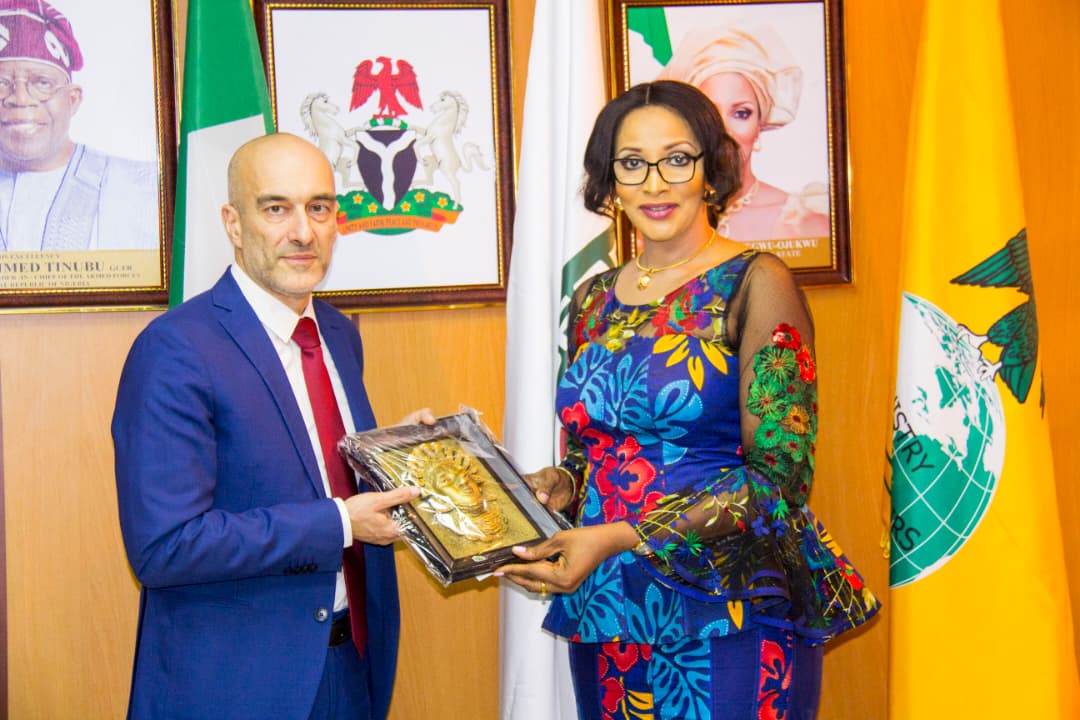
Irregular migration, insecurity, counter-terrorism top cooperation Nigeria and Italy are poised to deepen bilateral relations, Minister of State for Foreign Affairs, Ambassador Bianca Odumegwu-Ojukwu has said.
Despite the over six decades diplomatic ties with Italy, she noted that Nigeria did not have a bi-national commission with the country and called for one. The minister who stated this when the Italian Ambassador to Nigeria, Roberto Mengoni, paid her a courtesy visit in her office said that Italy remains a strategic partner for Nigeria in Europe, with bilateral ties reinforced by high-level visits.
According to her, those engagements have continued to underscore the shared interests of both nations in sustainable development, food security, and economic cooperation. “The strategic nature of this relationship is further evidenced by ongoing diplomatic consultations that address global challenges including climate change, irregular migration, and regional security concerns,” the minister said. She acknowledged and urged the sustenance of joint dedication to combating illegal migration, human trafficking, and transnational crime by both countries while inviting deeper Italian engagement in Nigeria’s economic reform agenda, particularly in sectors such as renewable energy, agribusiness, and infrastructure.
The minister also called for Italy’s technical support in Nigeria’s industrialization efforts, highlighting the importance of ease of mobility as a catalyst for trade, investment, education, and cultural exchange between the two counties. Odumegwu-Ojukwu emphasized that improving the efficiency of Visa issuance and processing will not only reduce delays and frustrations for applicants but also directly support economic cooperation and diplomatic engagement.
The minister further called for the establishment of efficient trade facilitation mechanisms that would enable Nigerian goods—especially agricultural and manufactured products—to reach the Italian market directly, reducing transit costs, improving supply chain efficiency, and enhancing market competitiveness. She identified migration as a challenge and an opportunity in Nigeria-Italy relations, as both countries worked to address irregular migration while facilitating legal pathways for movement.
Odumegwu-Ojukwu explained that the bilateral cooperation encompasses repatriation agreements, voluntary return programmes, and reintegration support for Nigerian nationals returning from Italy. She noted the joint initiatives tackling human trafficking networks that operate between both countries, with particular focus on protecting vulnerable populations. She added that the two nations had developed programmes to create economic opportunities in Nigeria that might reduce migration pressures, including vocational training and small business development projects in regions with high migration rates.
Odumegwu-Ojukwu said: “We are concerned about ways and means of combating irregular migration especially as Italy is a leading destination for Nigerian migrants. “We are looking at youth restiveness and initiatives in managing migration; looking at youth-focused initiatives that could give skills to the youths, create jobs and keep them busy. “We are appealing for assistance in dealing with online radicalization of our society; in building capacity to combat violent extremism.”
Earlier, Ambassador Mengoni said that his country was looking forward to improving bilateral relations with Nigeria, based on their policy strategy for building stronger cooperation and businesses with Africa. He explained that he arrived Nigeria recently and was determined to ensuring that Italy maximized the strategic place of Nigeria in the continent to the mutual benefit of both countries.