


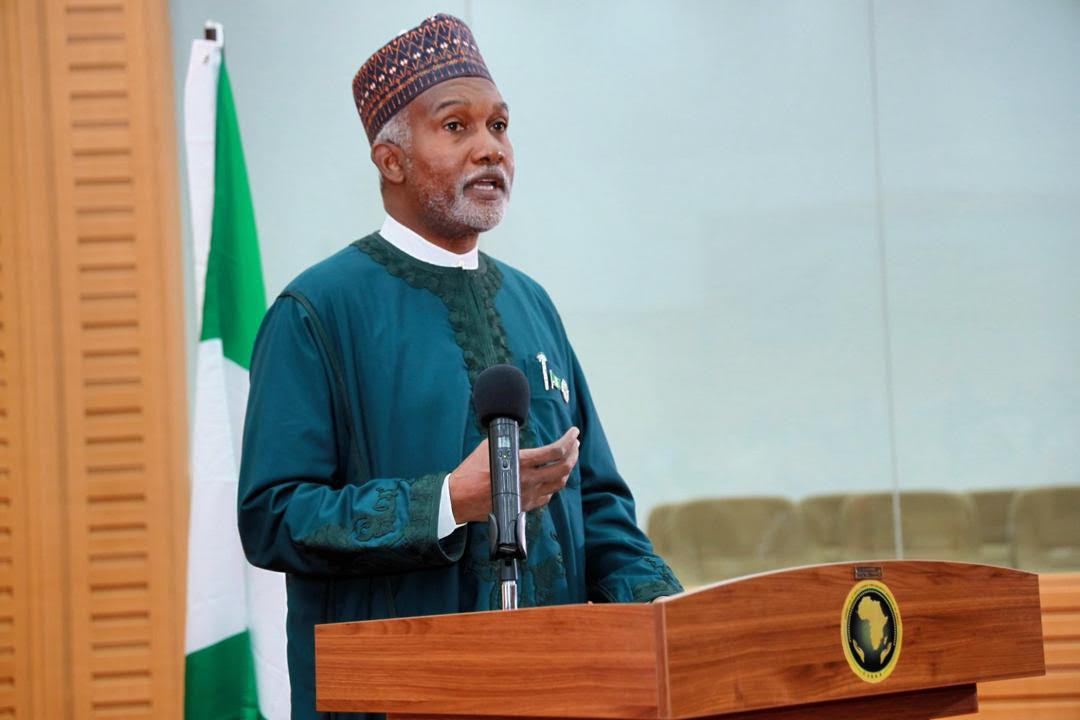
SPEECH BY HIS EXCELENCY YUSUF MAITAMA TUGGAR, OON, HONOURABLE MINISTER OF FOREIGN AFFAIRS AT THE HIGH-LEVEL MINISTERIAL FORUM ON REGIONAL PARTNERSHIP FOR DEMOCRACY, HELD IN ADDIS ABABA, ETHIOPIA ON 12 FEBRUARY, 2026
Protocols
I am pleased to welcome you to this High-Level Side Event convened on the margins of the Thirty-Ninth Ordinary Session of the Assembly of Heads of State and Government of the African Union. I extend Nigeria’s appreciation to the African Union Commission, the United Nations Development Programme, and our partners for their continued engagement in advancing democratic governance on our continent.
2. We meet at a moment when democracy in Africa, though widely affirmed in principle, is increasingly tested in practice. While citizens remain committed to democratic ideals, public confidence in democratic institutions has been weakened by governance deficits, unmet socio-economic expectations, and declining institutional performance. Democracy on the continent, therefore, must do more than survive; it must command trust through delivery.
3. It was in recognition of this imperative that Nigeria, in partnership with the United Nations Development Programme, launched the Regional Partnership for Democracy (RPD) in November 2025. Since its launch, the initiative has generated considerable interest among Member States, multilateral institutions, and development partners, many of whom are actively engaging with Nigeria on modalities of support. Nigeria remains open to additional partners, for the simple reason that the task of renewing democratic governance in our region cannot be carried out by one country, or indeed one institution, alone. As we say in Africa, a single head cannot carry a heavy load. Democracy is a shared enterprise, and its defence and renewal require collective effort.
4. The RPD is conceived as a preventive rather than a curative measure. Its purpose is not to respond after democratic breakdown has occurred, but to strengthen democratic systems in advance, thereby inspiring public trust and reinforcing institutional legitimacy. By enhancing the capacity, independence, and credibility of democratic institutions, the RPD seeks to avert the gradual loss of confidence in governance systems which, if left unattended, often creates fertile ground for external interference and, ultimately, unconstitutional changes of government.
5. The relevance of this preventive approach is particularly evident in West Africa, where democratic governance faces multifaceted threats. These threats do not emanate solely from military interventions. They also arise from within democratic practice itself; through weakened institutions, erosion of accountability, exclusionary politics, and the growing distance between political authority and popular consent. In such environments, democracy becomes vulnerable not only to internal decay, but also to external actors who seek to impose uniform governance templates that fail to reflect national realities.
6. Yet, legitimacy in any democratic system flows fundamentally from the people who are governed. Governance frameworks that are not rooted in local ownership and public confidence are inherently fragile. The RPD therefore places emphasis on strengthening institutions so that they are capable of performing their constitutional roles effectively and transparently, thereby reinforcing democratic legitimacy from within.
7. Drawing on the core democratic tenets embodied in the RPD, which are: constitutionalism, accountability, inclusion, dialogue, and institutional resilience, West Africa has witnessed instances in which threats to democratic order have been anticipated, contained and neutralised through collective action. Preventive diplomacy, peer engagement, and regional solidarity have, in these cases, ensured that democracy is accorded pride of place as the legitimate and preferred system of governance.
8. For democracy to deliver meaningfully and sustainably, it is my humble submission that three priorities remain paramount. First, there must be a sustained focus on strengthening independent, professional, and credible institutions, particularly electoral bodies, judiciaries, legislatures, and oversight agencies. These institutions must be empowered to operate free from undue influence and in strict adherence to their constitutional mandates. Second, democratic governance must be deliberately aligned with tangible socio-economic outcomes that directly respond to the expectations and lived realities of citizens. Citizens must experience democracy not only at the ballot box, but also through improved service delivery, job creation, social protection, and equitable development. Where democratic systems fail to address everyday realities, public trust inevitably wanes. Third is inclusive participation, especially of youth and women, who constitute the majority of our population yet remain underrepresented in decision-making processes. Ladies and gentlemen, this requires sustained investment in civic education, political inclusion, leadership development, and responsible digital engagement, so that participation is informed, constructive, and anchored in democratic values rather than misinformation or polarisation.
9. Engagement with the Regional Partnership for Democracy may therefore take several practical and mutually reinforcing forms. These include supporting institutional capacity-building initiatives and peer-review mechanisms that promote accountability and shared learning across countries. They also involve investing in civic education, youth empowerment, and inclusive governance programmes that broaden and deepen political participation. In addition, engagement may take the form of providing technical expertise, facilitating knowledge exchange, and mobilising predictable financing aligned with regional priorities and national ownership.
Finally, strengthening coordination with Regional Economic Communities and relevant African Union organs is essential to ensure coherence, complementarity, and the long-term sustainability of democratic support efforts. The RPD is designed as a flexible platform; one that welcomes diverse contributions, while remaining firmly grounded in African priorities and leadership.
10. In conclusion, Excellencies, ladies and gentlemen, Nigeria reaffirms its firm commitment to democratic governance, regional cooperation, and multilateral partnership. We remain convinced that democracy in Africa can be safeguarded most effectively through prevention rather than reaction. Through partnership rather than prescription, and through legitimacy grounded in public trust. It is by strengthening democracy before it falters that we secure its future.
11. I thank you for your attention and look forward to our deliberations.